
Über mich
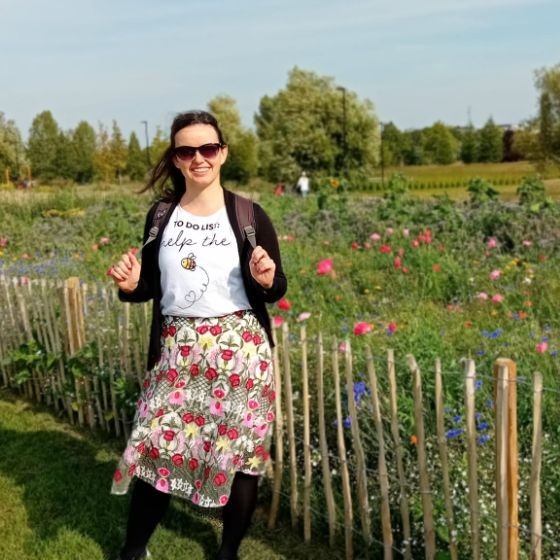
Ich kann mich noch daran erinnern, dass ich bereits im Alter von 5 Jahren vor Blüten hockte und Bienen ... Nein quatsch! :-) Viele Wissenschaftler haben ja so romantische Geschichten, dass sie bereits im frühen Kindesalter die Tiere beobachtet haben, die sie nun erforschen. Bei mir war das nicht so. Ich habe nicht mal wirklich super gezielt Biologie studiert. Ich war schon immer sehr vielseitig interessiert und wollte eigentlich nur mehr lernen und die Dinge verstehen. Es gab Praktika bei der Zeitung, im Anwaltsbüro, ein Schnupperstudium Mathematik und Medizin und dann war klar ... Biologie. Dort gibt es sehr viel zu verstehen, vor allem im kleinem, und so habe ich mich auf Molekularbiologie spezialisiert. Ganz eindeutig war ich nun auf direktem Weg zu den Bienen. Am Ende der Promotion hatte ich eigentlich gar keine Lust mehr auf akademische Forschung, aber dann hat mir ein Bienenprofessor von diesen super interessanten Proteinen erzählt, die es nur in Honigbienen gibt, und kurz darauf habe ich in Rumänien angefangen an Honigbienen zu forschen. Und wenn man einmal in die Welt der Bienen hineingesogen wurde, kann man vor lauter Faszination einfach nicht mehr zurück. Nun forsche ich schon seit 15 Jahren vor allem an Honigbienen und bin so bienenbegeistert, dass ich jede Biene fotografiere, die mir vor die Linse kommt.
Publikationen
- M García-Lozano, C Emmerich, C Henzler, I Koch, C Lanz, A Ayas, I Pons, A Buttstedt, K Hipp, H Salem (2026) Yellow protein co-opted to sustain obligate symbiosis in tortoise beetles. Nature Communications 17: 9446. DOI: 10.1038/s41467-026-76942-1
- Y Fang, B Ma, X Jin, A Buttstedt, YA Naggar, K Darragh, H Tian, Y Zhu, G Yang, Y Yang, Y Huang, W Li, R Xu, J Li, F Hu, L Wu, W Peng, X Xue, B Baer, K Wang (2026) Queen cell architecture shapes honey bee queen development. Nature 654: 689-696. DOI: 10.1038/s41586-026-10534-3
- A Buttstedt, CWW Pirk, AA Yusuf (2025) Differences in the suitability of published honey bee (Apis mellifera) reference genes between the African subspecies Apis mellifera scutellata and European derived Apis mellifera. Molecular Ecology 34: e17139. DOI: 10.1111/mec.17139
- A Buttstedt, CWW Pirk, AA Yusuf (2025) Conference contributions by section members of the International Union for the Study of Social Insects (IUSSI) at international IUSSI conferences (1952 – 2022) are not in accordance with membership numbers. Insectes Sociaux 72: 29-44. DOI: 10.1007/s00040-024-00997-w
- AA Yusuf, CWW Pirk, A Buttstedt (2024) Expression of honey bee (Apis mellifera) sterol homeostasis genes in food jelly producing glands of workers. Journal of Experimental Zoology Part A: Ecological and Integrative Physiology 341: 627-641. DOI: 10.1002/jez.2813
- A Buttstedt, CWW Pirk, AA Yusuf (2023) Mandibular glands secrete 24-methylenecholesterol into honey bee (Apis mellifera) food jelly. Insect Biochemistry and Molecular Biology 161:104011. DOI: 10.1016/j.ibmb.2023.104011
- A Buttstedt (2022) 10-Hydroxy-Δ2-decenoic acid’s role in the fibril formation of the major royal jelly protein 1/apisimin/24-methylenecholesterol complex isolated from honey bee (Apis mellifera) royal jelly. European Journal of Entomology 119:448-453. DOI: 10.14411/eje.2022.047
- CI Mureşan, DS Dezmirean, BD Marc, R Suharoschi, OL Pop, A Buttstedt (2022) Biological functions of major royal jelly proteins and their derived peptides. Journal of Functional Foods 98: 105286. DOI: 10.1016/j.jff.2022.105286
- BH Kramer, V Nehring, A Buttstedt, J Heinze, J Korb, R Libbrecht, K Meusemann, RJ Paxton, A Séguret, F Schaub, A Bernadou (2021) Oxidative stress and senescence in social insects: a significant but missing link? Philosophical Transactions B 376: 20190732. DOI: 10.1098/rstb.2019.0732
- JP Oeyen, P Baa-Puyoulet, JB Benoit, LW Beukeboom, E Bornberg-Bauer, A Buttstedt, F Calevro, EI Cash, ..., O Niehuis (2020) Sawfly genomes reveal evolutionary acquisitions that fostered the mega-radiation of parasitoid and eusocial Hymenoptera. Genome Biology and Evolution 12: 1099-1188. DOI: 10.1093/gbe/evaa106
- D Dobritzsch, D Aumer, M Fuszard, S Erler, A Buttstedt (2019) The rise and fall of major royal jelly proteins during a honey bee (Apis mellifera) workers’ life. Ecology and Evolution 9: 8771-8782. DOI: 10.1002/ece3.5429
- CI Mureşan, A Buttstedt (2019) pH-dependent stability of honey bee (Apis mellifera) major royal jelly proteins. Scientific Reports 9: 9014. DOI: 10.1038/s41598-019-45460-0
- T Kurth, S Kretschmar, A Buttstedt (2019) Royal jelly in focus. Insectes Sociaux 66: 81-89. DOI: 10.1007/s00040-018-0662-3
- P Winkler, F Sieg, A Buttstedt (2018) Transcriptional control of honey bee (Apis mellifera) major royal jelly proteins by 20-hydroxyecdysone. Insectes 9: 122. DOI: 10.3390/insects9030122
- CI Mureşan, A Schierhorn, A Buttstedt (2018) The fate of major royal jelly proteins during proteolytic digestion in the human gastrointestinal tract. Journal of Agricultural and Food Chemistry 66: 4164-4170. DOI: 10.1021/acs.jafc.8b00961
- A Buttstedt, CI Mureşan, H Lilie, G Hause, CH Ihling, S-H Schulze, M Pietzsch, RFA Moritz (2018) How honey bees defy gravity with royal jelly to raise queens. Current Biology 28: 1095-1100. DOI: 10.1016/j.cub.2018.02.022
- S Helbing, HMG Lattorff, RFA Moritz, A Buttstedt (2017) Comparative analyses of the major royal jelly protein gene cluster in three Apis species with long amplicon sequencing. DNA Research 24: 279-287. DOI: 10.1093/dnares/dsw064
- TV Vezeteu, O Bobiş, RFA Moritz, A Buttstedt (2017) Food to some, poison to others - honey bee royal jelly and its growth inhibiting effect on European Foulbrood bacteria. MicrobiologyOpen 6: e00397. DOI: 10.1002/mbo3.397
- A Buttstedt, CH Ihling, M Pietzsch, RFA Moritz (2016) Royalactin is not a royal making of a queen. Nature 537: E10-E12. DOI: 10.1038/nature19349
- T Pamminger, A Buttstedt, V Norman, A Schierhorn, C Botias, J Jones, K Basley, WHO Hughes (2016) The effects of juvenile hormone in Lasius niger reproduction. Journal of Insect Physiology 95: 1-7. DOI: 10.1016/j.jinsphys.2016.09.004
- CM Aurori, A Buttstedt, DS Dezmirean, LA Mărghitaş, RFA Moritz, S Erler (2014) What Is the Main Driver of Ageing in Long-Lived Winter Honey bees: Antioxidant Enzymes, Innate Immunity, or Vitellogenin? Journals of Gerontology, Series A 69: 633-639. DOI: 10.1093/gerona/glt134
- A Buttstedt, RFA Moritz, S Erler (2014) Origin and function of the major royal jelly proteins of the honey bee (Apis mellifera) as members of the yellow gene family. Biological Reviews 89: 255-269. DOI: 10.1111/brv.12052
- CI Pavel, LA Mărghitaş, DS Dezmirean, LI Tomoş, V Bonta, A Şapcaliu, A Buttstedt (2014) Comparison between local and commercial royal jelly - use of antioxidant activity and 10-hydroxy-decenoic acid as quality parameter. Journal of Apicultural Research 53: 116-123. DOI: 10.3896/IBRA.1.53.1.12
- A Buttstedt, RFA Moritz, S Erler (2013) More than royal food - Major royal jelly protein genes in sexuals and workers of the honey bee Apis mellifera. Frontiers in Zoology 10: 72. DOI: 10.1186/1742-9994-10-72
- A Buttstedt, T Wostradowski, C Ihling, G Hause, A Sinz, E Schwarz (2013) Different morphology of fibrils originating from agitated and non-agitated conditions. Amyloid 20: 86-92. DOI: 10.3109/13506129.2013.784962
- N Barbezier, A Chartier, Y Bidet, A Buttstedt, C Voisset, H Galons, M Blondel, E Schwarz, M Simonelig (2011) PABPN1 toxicity and aggregation in oculopharyngeal muscular dystrophy involve the protein folding activity of rRNA and are reduced by 6-aminophenanthridine and guanabenz. EMBO Molecular Medicine 3: 35-49. DOI: 10.1002/emmm.201000109
- A Buttstedt, R Winter, M Sackewitz, G Hause, FX Schmid, E Schwarz (2010) Influence of the stability of a fused protein and its distance to the amyloidogenic segment on fibril formation. PLoS ONE 5: e15436. DOI: 10.1371/journal.pone.0015436
- A Hauburger, S von Einem, GK Schwaerzer, A Buttstedt, M Zebisch, M Schräml, P Hortschansky, P Knaus, E Schwarz (2009) The pro-form of BMP-2 interferes with BMP-2 signalling by competing with BMP-2 for IA receptor binding. FEBS Journal 276: 6386-6398. DOI: 10.1111/j.1742-4658.2009.07361.x
Impressum
Bienenanja – Dr. Anja Buttstedt
c/o Autorenglück #90821 || Albert-Einstein-Straße 47 || 02977 Hoyerswerda
anja(at)bienenanja(dot)de